
Challenge Football
3M Company – 1972 – 2 PlayersChallenge Football, as you might expect, is a football game. The players represent the coaches of their teams and attempt to lead them to victory.
Gameplay is quite simple. The defensive player selects a “Playcard” corresponding to the Defensive Pattern they wish to execute and covers it with the “Cover Card”. The Playcard shows a pattern of triangles giving the coverage pattern of the play. The Cover Card only shows the triangles of the actual lineup at scrimmage. Both the Cover Card and the Playcard are placed in a clear plastic “Card Holder”. The Defensive player then secretly selects a “Shift Card” which shows either Left, Right or None. The Card Holder is then given to the Offensive Player.
The Offensive player then draws the run pattern they wish to use on the Card Cover. Special markings are used to show where passes or handoffs occur. The Cover Card is then removed. If the line drawn for the run pattern intersects a triangle on the Playcard the ball is considered to be down at that point. Passes which intersect triangles have a chance to be intercepted. If a Left or Right shift card has been played the triangles are considered to be one space to the left or right of their printed positions.
If the line does not intersect a triangle then the play results in a touchdown. Otherwise play continues from the point where the tackle occurred. The normal rules for football apply so players must advance at least 10 yards within four downs or be forced to turn the ball over to the other player. Special rules allow for punts, field goals, points after touchdowns, kickoffs and penalties. Kicked balls can be affected by the wind.
There are fifteen plays in a quarter and the game lasts for four quarters. The player with the highest score at the end of the game is the winner.
This is an interesting game but Challenge Football does not feel much like football to me. It is really a guessing game where one player tries to guess which card the other player has chosen. There is no way for one side to react to what the other has done so there is nothing to do but draw the line and hope. There are very few restrictions on how the line can be drawn (which can lead to some interesting running patterns) but this makes the game have even less to do with football. The way the line is drawn and the way the cards fit into the holder make it sometimes difficult to determine if a tackle has occurred and having to mentally shift all of the triangles to the left or the right depending on the shift card chosen only adds to the confusion.
The 3M sports game Thinking Man’s Football does a much better job as a football game in the standard 3M sports game format. I do not know why 3M felt the need to release a bookshelf format football game and this game certainly does not add much to the line.

 Challenge Bridge is a system designed to allow bridge players to play the same hands that were used in American Contract Bridge League (ACBL) tournaments. The game includes the results from the tournaments so players can rank their play against that of the championship level players.
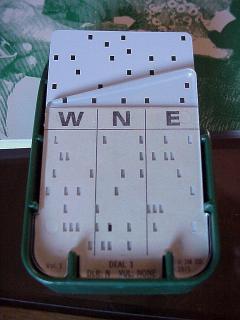 I am not much of a bridge player and when I first reviewed this game I really didn’t see the attraction to it. Fortunately, Paul Bernhardt, the Educational Chair for the Salt Lake City Unit of the ACBL saw my review and gave me the insiders view of the game. He has kindly allowed me to reproduce his e-mail here.
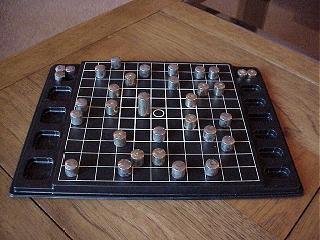 Breakthru is an abstract strategy game. One player, controlling the “gold fleet” receives 12 “escorts” and 1 “flagship”. The other player is the “silver fleet” and receives 20 ships. The gold fleet is set up in the central part of the board and the silver fleet in the outer part. The object of the game is for the gold player to get their flagship off the board before it is captured by the silver player.
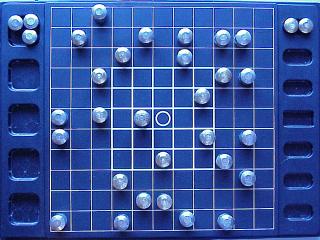 This is an interesting game with elements of both Chess and Fox and Hounds. The naval fleet metaphor is really meaningless in the context of the game; it is an abstract strategy game with no element of chance.
 Bazaar is a trading game. The players attempt to collect the proper combination of colored “tokens” to allow them to buy “wares” from the “stalls” in the bazaar. They collect tokens by trading for them using the “exchange rate cards” in use for the game.
 This is one of those games that fits the cliche “easy to learn, difficult to master”. The basic concepts are quite simple but in execution the game gets complex very fast. You can trade tokens to get just the right combination for buying a ware to get a high score but by that point your opponent may have bought two or three lower scoring wares that result in a higher total. There are ten exchange rate cards, only two of which are used at any one time and 45 wares cards of which only 20 are used in a game which means each game is different. Another classic 3M game.
 Backgammon, another entry in the 3M Bookshelf Classics series, has existed for over five thousand years. It is a race game, having elements of both skill and luck.
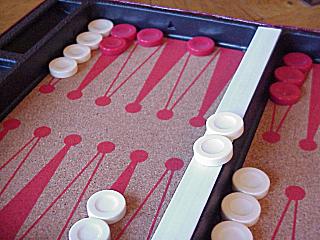 Backgammon has a near perfect balance of skill and luck. Moving some pieces leaves others vulnerable to being sent to the bar and savvy players will leave some pieces behind to attack their opponents with. But, a bad roll of the dice can destroy the best laid plans.
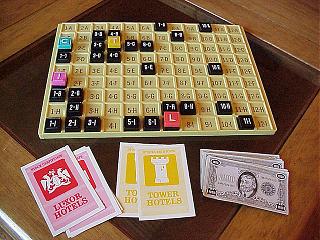 Acquire is a game of hotel investment and development. The game is played on a 12 x 9 numbered grid. The players take turns placing numbered tiles on the corresponding square on the grid. The tiles represent hotels. When two or more tiles are placed adjacent to each other a “chain” is formed. Players may purchase stock in hotel chains. The more tiles which make up the chain the more the stock is worth.
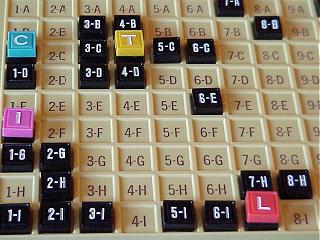 A chain of 11 or more hotels cannot be taken over and is called a “safe” chain. When all of the chains on the board are “safe” and no more tiles can be played the game is over. The players calculate their stock values and the player with the highest net worth is the winner.